WELCOME to WELNEY !
Page good for smart-phones. On PCs/Laptops it may look too large. To reduce press "Ctrl" & "minus" or click "View" then "Zoom out"
Created Feb 2005, last edited: 16/03/26, 17:03
Created Feb 2005, last edited: 16/03/26, 17:03

Introduction
Welney is both a small village and a civil parish in the south-west corner of the county of Norfolk, adjacent to the border with the county of Cambridgeshire, in a region of eastern England known as East Anglia.We are in the centre of the small spot on the outline map of the UK, and just below the N in FENS

 Below, left, Welney Parish boundary;
right, surrounding towns and villages

 In a wider sense, Welney is also a community encompassing properties and areas in other parishes, other counties. This website is for that
community, and for our friends, relatives and "ex-pats" all over the world.
In a wider sense, Welney is also a community encompassing properties and areas in other parishes, other counties. This website is for that
community, and for our friends, relatives and "ex-pats" all over the world.The Welney Website
The site is independently managed, privately financed and totally impartial, being free of control or influence by local authority, commercial or ecclesiastical sources. It has served the community since 2000.There are no pop-ups or adverts, just Welney stuff, but like virtually all sites we do use cookies for analysis and features such as the visitor counter and the search facility. You can read its history, management, technical details and the 'small-print' in the About link on the Content page.
Scroll down to read on, or use the menu bar and choose a section to jump to. But please do read the whole page as soon as you can.
Area and land
The parish of Welney covers 2056 hectares (5080 acres). The land is flat and low-lying and the soil is mostly very fertile black peat with some silt. It is part of the area known as Fenlands, or "the Fens" once swampy and eerie with small islands of habitation, but now drained by a complex system of ditches, dykes and rivers.Population
Within the parish there are about 210 dwellings housing just over 500 people (2001 data).There are three main areas of habitation: in the centre, the small village of Welney; to the north-west, the hamlet of Tipps End; and to the south-east the settlements at Suspension Bridge and Gold Hill, plus a straggle of houses spread out northeast along the Hundred Foot Bank. If we include adjoining areas which this website covers, we could add perhaps 30 to 40 properties, say another 70 people.
Amenities
We have a church, primary school, pub and restaurant, parish hall, playing field with sports pavilion, and a retirement home. Like many rural communities we have lost several local services in recent years. Our post office and shop closed in June 2007, but postal services are available for an hour or so daily from a mobile post office and local shops are nearby in the villages of Upwell and Manea, and many more shops and a supermarket in the small town of Littleport. We are surrounded by the small market towns of Wisbech, Downham Market, Chatteris and March, and the catherdal city of Ely.(See 'information centre' for details of many services for residents and visitors.)
Sounds straightforward, but it isn't .....................
Once, Welney was part of the parish of Upwell. It was also partly in the county of Norfolk and partly in Cambridgeshire. And for many years, the part in Cambridgeshire was actually in the county of the Isle of Ely. OK so far?The eastern part of the parish is separated from the rest by three man-made parallel rivers. Contained by them is a flood plain, 21 miles long in total, although only a 5 mile section is in Welney.
It's the UK's largest floodwater storage area, "The Hundred Foot Washes", although since the 1970s commonly known as the Ouse Washes, and designated a Site of Special Scientific Interest.
Sometimes flooding can make travel across the washes on the A1101 main road a little difficult ....... A regular problem for many years.


Left, part of the washes looking north-east; Old Bedford and Delph Rivers side-by-side on left: New Bedford or Hundred Foot River on right; WWT reserve in centre.
right, looking south-east from the Delph Bridge at Welney onto the flooded A1101 Wash Road across the Washes
Suspension Bridge
Suspension Bridge hasn't had, or been, a suspension bridge since 1926, Gold Hill doesn't have gold or a hill; the Hundred Foot Bank is neither 100 feet high, wide or long, and is actually one bank of the New Bedford River otherwise known as the Hundred Foot River, which is tidal, but sometimes called a drain; and the two side-by-side rivers on the west of the washes are known in the south as the Counterdrain and the Old Bedford River, but north of Welches Dam the Old Bedford River becomes the River Delph and the Counterdrain is known as the Old Bedford River. Oh, the Old Bedford/River Delph and New Bedford/Hundred Foot rivers are really just parts of the Great Ouse River.The name of the western hamlet is shown on the road signs and most maps as Tipps End; other maps show Tipp's End or Tips End (and on one early map as Type's End); the Post Office and some locals spell it Tipsend. It is also split administratively - just less than half the houses are in the Norfolk parish of Welney, a couple are in the Norfolk parish of Upwell, and the rest are in the Cambridgeshire parish of Christchurch.
All of which makes addresses, directions or historical research a little difficult.
Our world-famous wetlands
The area was once the centre of ice-skating in England, and Welney had a world champion and several British ones. Sadly, warmer winters make ice a rarity here now, but we still have a skating club.Fishing in the River Delph (right) and the Old Bedford River is fortunately still very popular, attracting anglers from far and wide. Pike up to 28lbs (13kg), zander, roach, bream, perch and rudd can all be found.
Wildfowling, the shooting of ducks, was also once popular and the area supplied vast quantities of ducks for the London markets shot by wildfowlers in punt boats using 8 foot l ong punt guns.
Conservation
Nowadays the emphasis is on conserving and protecting wildfowl rather than killing them, and most outsiders seem to have heard of Welney because of the swans that visit here every year.The Wildfowl and Wetlands Trust (WWT) reserve in the Ouse Washes north east of Welney village has been the winter home of thousands of swans and ducks from northern Europe and the Arctic for more than 35 years.


Over 8,000 Bewick's and Whooper swans now over-winter here, together with thousands of ducks especially Wigeon, Lapwing, Mallard, Pintail, Pochard and Teal, and wading birds such as Plover. The regular floodlit evening swan feeding (right) is a popular and unforgettable sight.
Conservation and the environment are also the themes of other Welney organisations, too.
Giles Landscapes won silver medals in 2004 and 2005 for its Wildlife Trust gardens at the world-famous annual Chelsea Flower Show in central London. (They did not exhibit in 2006.)


Left, the 2004 garden with lych gate and trellis, right, the 2005 one with cedar cabin.
In 2009 they won, at last, a Gold, for their 'Fen Ben' alchemist garden. More about that later!
The Pisces Country Park, previously known as Pisces Caravan Park and Fishery, has been awarded three successive annual gold medals since 2003 from the David Bellamy Conservation Organisation for its 22 acre holiday site, now with lakeside lodges available on 50 year leases.


Welney also has what is possibly the largest steam distillation plant of its type in the UK, producing high quality essential oils and floral waters from locally grown aromatic herbs supplied by a number of small farmers who are members of a co-operative.
Crops such as chamomile, peppermint, thyme, angelica, and lavender are a welcome change for residents from the traditional - and very muddy - root crops such as potatoes and sugar beet.


Recreation & sport
Welney is world-renowned not just for swans but also for fishing and skating


We also had a village cricket team who were hosts in May 2002 to a first-class county team which included a famous ex-England test fast bowler. In 2005 two ex-England players made guest appearances for Welney. Sadly, the club did not survive the long layoff due to the Covid pandemic of 2019-20 .
 And in August 2004 a small group who first got together just four months previously, put on a Gala and Dance which raised nearly £4,000 for children's play equipment.
Not bad for a small fen community!
The village sign
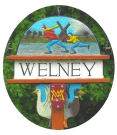
 Erected in Main Street just outside the church in 1978, it depicts ice skaters, a windmill draining the land, wildfowl,
and the entwined initials 'WM' below the village name.
Erected in Main Street just outside the church in 1978, it depicts ice skaters, a windmill draining the land, wildfowl,
and the entwined initials 'WM' below the village name.The actions of 'WM' - William Marshall - and also those of the 4th Duke of Bedford and the Dutchman Cornelius Vermuyden, have hugely influenced Welney ever since the middle of the 17th century.
Left, the old sign as shown on the cover of the 1999 Parish Appraisal; Right after repairs and repainting. Spot the changes.
More about the sign
What this site offers
To learn more of these and many other facets of Welney life from prehistoric times to the present day please take a good look around. The contents page has a detailed site index and search facility. Most pages have links at the bottom to related pages on this or other sites. In all there are well over 200 pages, and hundreds of photos from Victorian times to the present day.Please note from 2016-2025 the site only had limited updates due to other commitments. Much of this page and many others are out of date, but still serve as an historical record of the parish and its people. During that period, the smart-phone changed on-line viewing and in late 2025 the task of turning pages written for viewing on PCs and Laptops to be "phone-friendly" began. By March 2026 only a very few pages have been re-styled, but the task should gather pace later in the year. Revising content will take longer.
But with such a huge content, please contune to visit, there's bound to be more for you to find and enjoy here than you read in one visit.
Please note external links will open in a new window or tab. Links were correct in Feb 2016, but are subject to change by the site owners.
Acknowledgements
More than thirty people have contributed information, memories and photos to parts of the site. Whenever possible, all sources are acknowledged, as a courtesy of course, but also to enable verification of data.Site designed and maintained by the Welney Webmaster, Peter Cox. Text and photos except where noted © Peter Cox, 2004-2026
If you think there are any errors or ommissions on this page or would like to comment, please e-mail welney webmaster and your response will be added.
The Welney Website